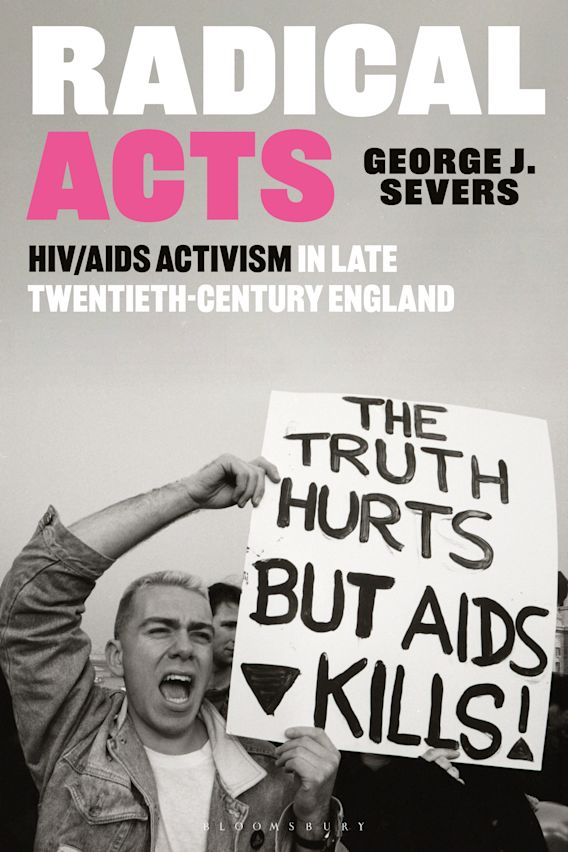
Drawing on activist campaign literature and materials, broadcast media, and new oral history interviews, Radical Acts reconstructs and discusses the overlooked world of radical AIDS activism in England. This book provides one of the first detailed histories of the radical HIV/AIDS movement in England, following ACT UP’s travels from New York to London via prominent queer intellectuals, and reconstructing the vibrant theatrical campaigns staged by ACT UP groups across England.
Radical Acts explores expressions of activism that were far more common than demonstrations and marches. Manifestations of a political commitment to ameliorating the injustices facing people living with HIV permeated most aspects of everyday life. These forms of ‘everyday activism’ played out in workplaces, universities and church halls across England, as well as through networks that stretched across Europe and North America. This book breaks new ground by studying the radical alongside the everyday, presenting a diverse constellation of activist responses to the epidemic.
Composing and Narrating Black Memories of Sexual and Reproductive Health in Jamaica and England in 1990s Birmingham
This open-access article examines the ways in which sexual and reproductive health themes appear in the Birmingham Black Oral History Project. As a community Black oral history project, it did not set out to collect memories of sexual or reproductive health. Despite that, the collection offers rich insights into the underexplored place of sexual and reproductive health within Black British histories. The article argues that archived oral history interviews should be “reused” as part of that historiographical exploration. It analyses the ways in which dominant interest in questions of “illegitimacy”—interest that had colonial roots—led to memories of sex education, courtship, and access to abortion in mid-twentieth-century Jamaica. Through a case study analysis of one interviewee—Carlton Duncan, father to the first “Black test tube twins”—the article concludes by arguing that being attentive to interviewee composure makes more visible the availability of narratives and cultural discourses through which interviewees could narrate or shape their sexual and reproductive health histories. As a whole, the article offers a new lens on postcolonial British history by analyzing the racist stereotyping that endured across the postwar period, especially in relation to Black sexuality and fertility.
You can read this via the Journal of British Studies here.
Queer citizenship in 1990s Britain, Contemporary British History
This article argues that the 1990s was a distinctive period in the British queer experience. A perceived rise in violent homophobic attacks marks the decade out, as does the activist culture which emerged to counter it. The article argues that ideas of citizenship became an important vehicle for queer activists, especially when challenging legal inequalities such as the age of sexual consent for gay men. Queer citizenship campaigns highlighted the state of legislated inequality for queer Britons which was seen to be worsening during the 1990s. This article examines two main examples of such campaigns, grassroots direct-action movements and legal test cases, arguing that queer citizenship was an increasingly useful concept for queer activists and campaigners.
You can read this article open access here.
Male rape: survivors, support and the law in late twentieth-century England and Wales, History Workshop Journal
Until 1994, men were not recognized legally as victims of rape in England and Wales. This article explores the history of male survivors of rape there, establishing the uneven patchwork of support services available to them prior to 1994. It argues that a growing psychiatric literature which studied male survivors of sexual violence was a major factor in convincing lawmakers to include men as potential victims of rape in updated sexual offence legislation. Other medical professionals played key roles in bringing male survivors to police attention, but psychiatric research was most influential in changing the policy agenda in this arena.
Read this article here open access.
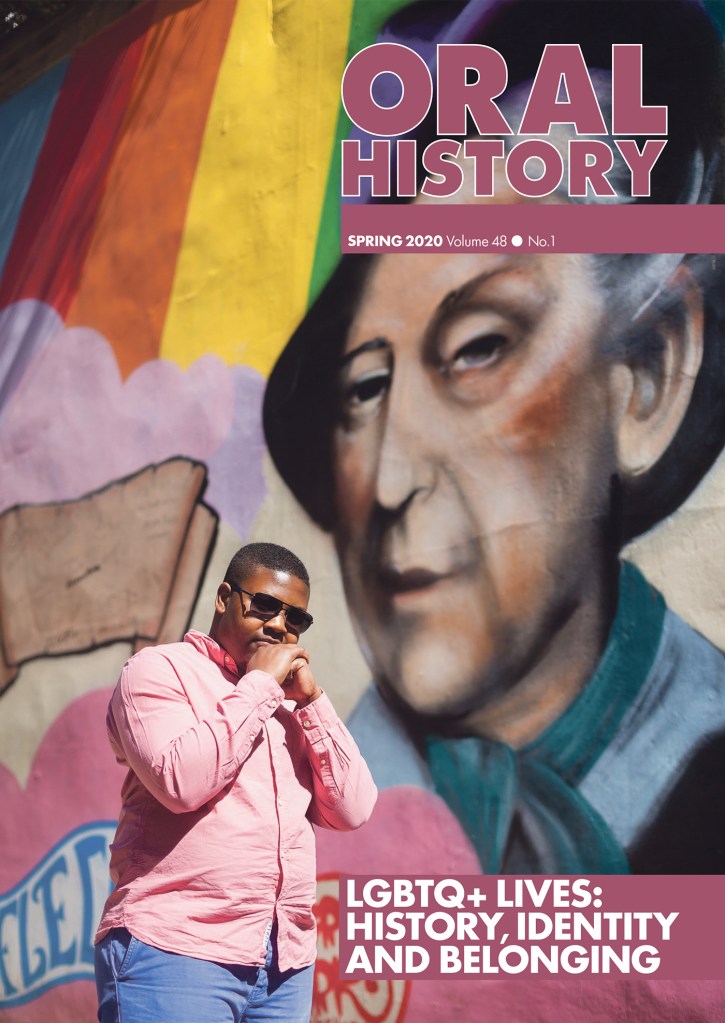
‘Reticence and the Queer Past’, Oral History, Vol. 48, No. 1 (Spring 2020), pp. 45-56.
‘Oral History’, in Theory, Method and Historiography Collection (Bloomsbury History: Theory and Method series, 2022), access here.
This article uses a moment of discomposure and reticence within an interview with an openly gay Church of England priest about the HIV/AIDS epidemic in England to discuss ‘queer reticence’, namely the extent to which a mutually imagined ‘queer past’ shaped the interview. I question why my interviewee was reluctant to speak about the death of a monk in his care, and of my unwillingness to question him further. I then discuss how the building up of a public queer image and the construction of a queer past, especially around the HIV/AIDS epidemic, can result in silences, discomposure and moments of reticence which are anchored in a personal and political deference to an imagined and highly desirable queer history, one which was especially difficult to broach intergenerationally. Abridged and reprinted as ‘Queer intergenerational reticence: a religious case study’, in Clare Summerskill, Amy Tooth Murphy and Emma Vickers (eds.), Archives of Disruption: New Directions in Queer Oral History (London: Routledge, 2022).
An introduction to the history, development, theories and methods of oral history.
LGBTQ+ lives: history, identity and belonging’, Oral History, Vol. 48, No. 1 (Spring 2020)
Special issue of Oral History co-edited with Dr Amy Tooth-Murphy, Dr Emma Vickers and Prof Christine Wall.
‘The ‘obnoxious mobilised minority’: homophobia and homohysteria in the British National Party, c. 1982-1999’, Gender and Education, Vol. 29, No. 2 (2017), pp. 165-181.
This article examines the British National Party (BNP)’s opposition to gay men during the 1980s and 1990s. Drawing on the sociological concept of ‘homohysteria’, it examines written material from BNP publications during those decades, looking specifically at the AIDS crisis, the party’s belief in a ‘queer conspiracy’, and the role which homosexuality played in the decline of the National Front and the birth of the BNP. The first study dedicated to British fascism’s anti-gay prejudice, this article argues that the existing scholarship fails to understand the degree and nature of anti-gay sentiment in the BNP, concluding that the party was homohysteric from its inception.
Reprinted in Nigel Copsey and Matt Worley (eds.), ‘Tomorrow Belongs to Us’: The British Far Right since 1967 (London: Routledge, 2018) and in Cynthia Miller-Idriss and Hilary Pilkington (eds.), Gender and the Radical and Extreme Right (London: Routledge, 2018).
 George Severs